
‘There’s nothing more important than the SAVE America Act’
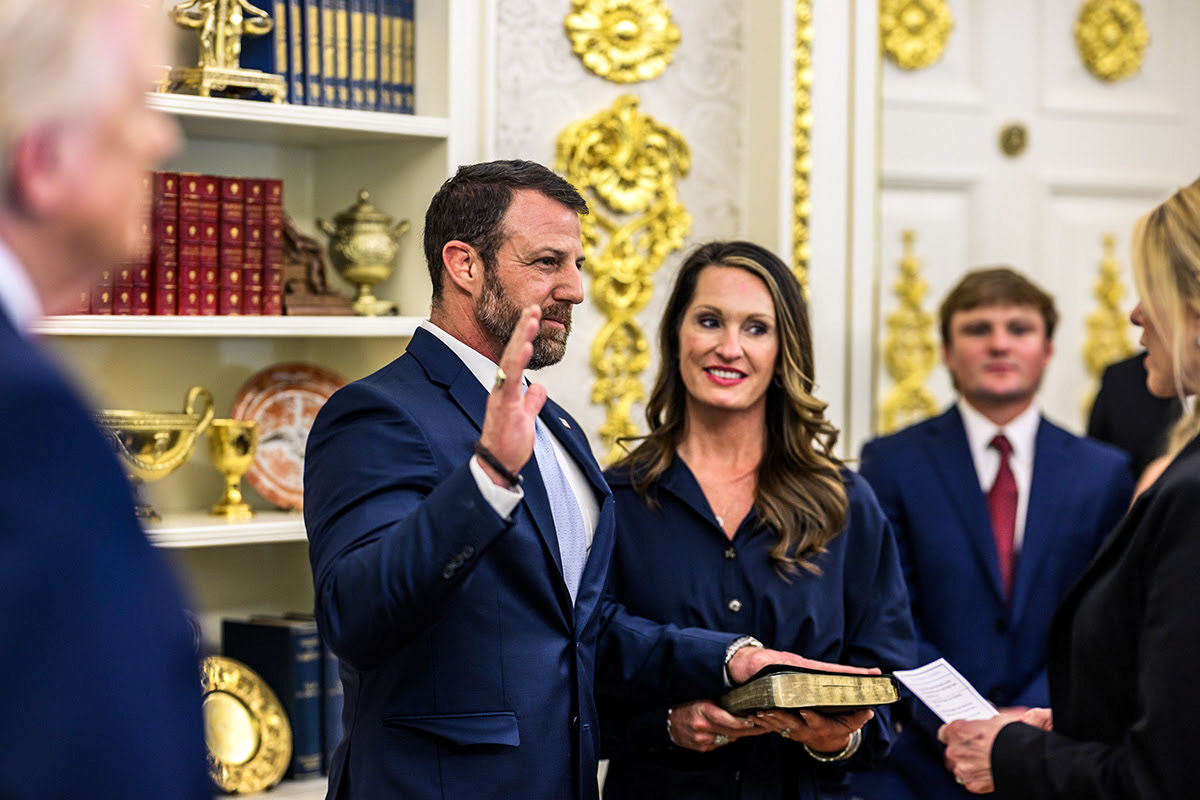
Secretary of Homeland Security Markwayne Mullin is quickly following orders as the first Native person in President Donald Trump’s cabinet.
Speaking at his swearing-in ceremony on Tuesday, Mullin once again endorsed the SAVE America Act, a controversial voter identification and registration bill that Trump has fixated on in recent weeks. Despite opposition to the Republican-sponsored measure from Native advocacy groups, the new leader of the Department of Homeland Security (DHS) is sharing the president’s enthusiasm for getting it passed in the 119th Congress.
“There’s nothing more important than the SAVE America Act,” Mullin, a citizen of the Cherokee Nation, said at the White House. “I mean, that’s what the American people want.”
“Eighty percent of the population say they want only Americans voting — citizens that are registered to vote, citizens that have done it the right way,” Mullin continued. “And I believe that everybody wants an election integrity.”
But while DHS plays a role in protecting elections infrastructure, tribes and their advocates have questioned the need for the Safeguard American Voter Eligibility Act, known alternatively as the SAVE Act and the SAVE America Act. According to the Native American Rights Fund (NARF), the bill prevents American Indians and Alaska Natives — who are citizens of the United States — from relying on their tribal identification cards by requiring them to produce other documents that are costly and often difficult to obtain, especially for those living on reservations and in rural and remote areas.
NARF also points out that the SAVE Act discourages mail-in voting by requiring voters to produce proof of American citizenship documents — in person. Polling places and local government offices are typically far from reservations, so the requirement places additional burdens on Native people.
“We are still navigating challenges around fair representation and equal access, ensuring Native votes are not diluted and Native voters are not shut out,” National Congress of American Indians (NCAI) Executive Director Larry Wright Jr. said last month.
“Our position is straightforward: Native voters must have equal access and an equal voice,” Wright said at NCAI’s executive council winter session in Washington, D.C., on February 9.
“We will continue supporting tribal nations working to protect that right.”
Democrats who spoke at NCAI’s meeting also criticized the push for the SAVE Act. Rep. Teresa Leger Fernández (D-New Mexico), whose district in New Mexico includes 18 tribal nations, called it a “voter suppression bill.”
“I’ve had numerous tribal leaders reach out to me because they are worried that it will make it harder for tribal members to register and vote with their tribal ID,” Leger Fernández, who is the highest-ranking Democrat on the House Subcommittee on Indian and Insular Affairs, told NCAI on February 10.
Rep. Hakeem Jeffries (D-New York), the highest-ranking Democrat in the U.S. House of Representatives, also brought up Native voting rights. In a video message, he promised support from his entire party.
“Any effort to suppress voting rights in Indian Country violates tribal sovereignty and will be met with swift and decisive opposition from House Democrats,” Jeffries said in the message on February 11. “We will not back down. We have your back.”
But Democrats aren’t the only ones worried about the impact on Native voters. Sen. Lisa Murkowski (R-Alaska), the Republican chair of the Senate Committee on Indian Affairs spoke out against the SAVE Act in a lengthy speech on Monday that laid out the numerous logistical, financial and even physical challenges that people in Alaska face when exercising one of the most fundamental constitutional rights.
“So if you are a 17-year-old girl who lives in Savoonga, you are turning 18 in October,” Murkowski said of a remote Yup’ik community on St. Lawrence Island in the Bering Sea, nearly 200 miles from Alaska’s mainland.
“Super excited because you are going to be able to vote for the first time ever. So what is this young person going to have to do in order to register to vote?” Murkowski continued.
“She is going to have to book a flight to Nome — so it is not that far, but it is all across water,” Murkowski said. “There is no boats that take you there. But that flight —- we don’t have jets out of St. Lawrence Island, so it is a propjet. It is going to cost you $720 just to start. The flights, if there is one a day, you are lucky; that is good. But you are going to have to stay overnight because you can’t return on the same day.”
“There aren’t a lot of hotels in Nome. A night at the Aurora Inn is $310, but I would guess that since the Iditarod is going on right now and there is a lot of excitement there, it is probably a little over $310,” Murkowski added. “Then you add in food for the day, cab fare.”
“You are probably looking at, at least $1,000 — at least $1,000 — for a quick day trip to go to Nome to register so that you can present your documentation so that you have the privilege to vote,” Murkowski asserted.
Opposition has put a big question mark on the SAVE Act — at least in the Senate, where Republican leaders have not committed to bringing it up for consideration even after it already passed the House. That’s why President Trump was asked on Tuesday about alternative methods of getting the bill over the finish line.
But rather than answer the question about using the reconciliation process to enact the SAVE Act — or key portions of it — Trump told Mullin to respond.
“There’s a framework that we can do through reconciliation, paying for it, put some of the policies that cost money in,” Mullin said of the effort being explored on Capitol Hill.
“And I think that was said so beautifully, so concisely, so well … that we should let him have the last word,” Trump said as he brought Mullin’s swearing-in ceremony to a close at the White House.
Trump nominated Mullin to serve as the DHS Secretary on March 5 after ousting Kristi Noem, a former governor of South Dakota, from the post amid significant criticism of her leadership. In January, two Americans — Renee Nicole Macklin Good and Alex Jeffrey Pretti — were killed by agents from the U.S. Immigration and Customs Enforcement (ICE), which is part of DHS, and several tribal citizens were arrested and detained by ICE despite being American citizens.
During NCAI’s meeting in February, ICE’s activities in Minnesota, Arizona, Oklahoma and other states were on the minds of many. But tribal issues only came up briefly during Mullin’s confirmation hearing last Wednesday.
“I respect tribal sovereignty,” Mullin said when asked about consulting tribes whose homelands lie along the U.S. border with Mexico.
Mullin barely made it out of the Senate Committee on Homeland Security and Governmental Affairs, whose Republican chair, Sen. Rand Paul (R-Kentucky), called him unfit to serve. The two clashed repeatedly over past and ongoing rivalries but there was little stopping the nomination from moving forward.
As a result, the Senate voted 54 to 45 on Monday to confirm Mullin as Secretary. Two Democrats joined Republicans in backing Mullin, who as a member of the chamber was allowed to vote for his own nomination.
‘Native American? I didn’t know that’
Following his election in November 2022, Mullin became the only tribal citizen in the Senate after serving five terms in the House. Trump expressed surprise at the achievement on Tuesday.
“But as the only Native American — I didn’t know that, huh?” Trump said in reference to Mullin’s tenure in the Senate.
“Let me look at you,” Trump said in the Oval Office with Mullin and his family just a few feet away. Throwing his hands in the air, the president concluded: “I think that’s alright.”
DHS is currently in a partial shutdown as Republicans, Democrats and the White House have failed to come an agreement about potential immigration reforms. Fiscal year 2026 appropriations for ICE and certain other agencies, including the Transportation Security Administration, lapsed on February 14.
An appropriations bill pending in Congress calls on DHS to “consult and coordinate with tribal governments” — including on training to ensure ICE agents and other federal employees are able to deal with tribal identification documents.
Speaking in D.C. in February, NCAI President Mark Macarro noted that he heard from a number of tribal leaders about ICE’s crackdown. He said consultation is key when it comes to respecting tribal sovereignty.
“They don’t want to see unilateral action by the Department of Homeland Security in the government-to-government relationship,” Macarro said at a news conference with Native reporters following the State of Indian Nations address on February 9.
“Consultation is something that’s very important and especially on this issue of potential ICE enforcement.”
“IF there’s a takeaway to all of this … [it] would be to don’t act unilaterally,” continued Macarro, who serves as chair of the Pechanga Band of Indians from California. “Meet government-to-government with tribal leadership wherever this is happening, and engage respectfully.”
When it comes to voting, NCAI Executive Director Wright said the organization is ready for the upcoming mid-term elections, which will determine whether Republicans continue to control the House and the Senate in the U.S. Congress.
“NCAI provides direct grants to tribal nations to support Native vote efforts,” said Wright, a former chair of the Ponca Tribe. “We are ramping up these efforts for the 2026 election.”
Come November, voters in Oklahoma will choose a permanent successor for Mullin, who had served on the Senate Committee on Indian Affairs. About 14.2 percent of the population identifies as American Indian alone, the largest such percentage in the lower 48. The state is home to to 39 federally recognized tribes — including the Cherokee Nation, whose membership ranks as one of the two largest in the U.S.
In the meantime, energy executive Alan Armstrong is serving in the Senate for the remainder of the year. He was sworn into office on Tuesday.
The SAVE Act passed the House as H.R.22 on April 10, 2025. But when the bill failed to gain traction in the Senate, the chamber added the voter identification and registration provisions to a different measure, S.1383, and passed it on February 11, 2026. The updated version was then sent back to the Senate, where it remains.
In the Senate, the SAVE Act is S.128. The SAVE America Act is S.3752.